

Supervision: Professor Dr. Hasan Almomani
Prepared by (Research Fellow): Emad Al-Hammadin
First: Background
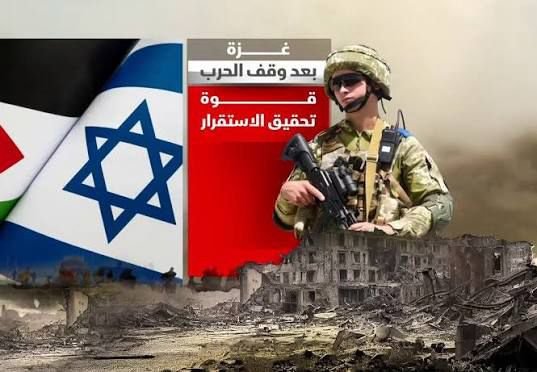
International efforts to establish an international stabilisation force (ISF) in the Gaza Strip have revealed clear divergences among concerned states, largely due to persistent ambiguity surrounding the mandate, scope, authorities, and rules of engagement of such a force. While some non-Arab Islamic countries—most notably Indonesia, Azerbaijan, and Pakistan—have expressed preliminary willingness to participate, these states remain hesitant to move toward actual deployment. In contrast, Arab states have refrained from openly endorsing participation, given the political and security sensitivities of the Palestinian arena and its complex dynamics.
Within this context, Turkey has emerged as the most proactive actor seeking a leading role in the proposed stabilization force. According to statements by the Turkish Foreign Minister, Ankara views the Gaza issue as highly complex and politically sensitive, requiring the protection of Palestinian interests, the uninterrupted flow of humanitarian assistance, and the reconstruction of Gaza. Turkey argues that for any stabilization arrangement to succeed, it must rely on a professional force that is acceptable by Hamas and other Palestinianresistance factions, a condition Ankara considers essential for the sustainability of any future security framework.
Second: The Core of the Turkish–Israeli Dispute
Turkey and Israel fundamentally diverge over the issue of disarming Palestinian factions. Israel views disarmament as a prerequisite for launching the second phase of the U.S. peace plan. Turkey, however, advances an alternative approach, arguing that disarmament should not occur during the second phase, but rather at a later stage—after humanitarian aid has been delivered, reconstruction has begun, and lines of contact have been stabilized—only then should factions be asked to hand over their weapons.
President Recep Tayyip Erdoğan reportedly proposed postponing disarmament for two years, a proposal Israel rejected outright. From the Israeli perspective, delaying disarmament effectively ensures that weapons will not be surrendered, but rather upgraded, while factions may gradually shift their allegiance toward Turkey following Iran’s relative retreat. Israel believes this would allow Hamas to continue stalling while rebuilding its military capabilities under the cover of humanitarian access.
Israel also considers Turkey non-neutral in this matter. Israeli officials argue that Turkey’s current leadership, which they associate with political Islam and movements close to the Muslim Brotherhood, holds an anti-Israeli agenda and lacks transparency regarding its intentions in Gaza. Against this backdrop, Israeli Prime Minister Benjamin Netanyahu’s upcoming visit to Washington is expected to focus on a categorical Israeli rejection of any Turkish role, not only in leading the stabilization force but in participating in it as well.
Israel understands that accepting Turkey would undermine its ability to impose its own security and political vision for Gaza and would derail Netanyahu’s plans centered on dismantling Hamas, disarming factions, and restructuring the Strip in a manner aligned with his domestic political calculations ahead of upcoming elections.
At the same time, Turkey possesses strong leverage. Turkish participation could significantly increase the likelihood of success of the U.S. president’s plan. Most importantly, the presence of Turkey would provide political cover for Islamic countries to contribute forces, making participation easier to justify domestically. More critically, Turkey’s relationship with Hamas could help ensure that the stabilization force is not targeted by armed factions should conditions deteriorate. This consideration represents a powerful incentive for Washington—one that may be difficult for President Trump to disregard in favor of Netanyahu’s objections.
Third: Israeli Security Concerns Regarding Turkish Participation
Israeli apprehension regarding Turkey’s involvement extends well beyond concerns over delayed disarmament. From Israel’s perspective, Turkish participation poses several direct threats to its national security:
- Military and Intelligence Capabilities: Israel views Turkey as a state with advanced military and intelligence capabilities, enabling it to monitor lines of contact and impose rules of engagement that could significantly restrict Israeli operational freedom, potentially exposing Israeli forces to risk and increasing the likelihood of a direct confrontation with Turkey.
- Intelligence Exposure: Israel fears that Turkey would seek access to sensitive intelligence held by Hamas regarding Israel, including data and materials acquired during the 7 October attack. Such access could substantially increase Israel’s strategic exposure to Turkey.
- Political Influence and Mediation: Turkey enjoys strong ties with Hamas, broad popularity among Gaza’s population, and working relations with other factions as well as the Palestinian Authority. Israel fears that this could facilitate Palestinian national reconciliation, returning Israel to “square one,” particularly as it remains firmly opposed to the emergence of any future Palestinian political entity.
- Undermining Israeli Objectives: Israel does not appear genuinely invested in the success of a stabilization force. Turkish leadership of such a force would undermine Netanyahu’s long-term objectives in Gaza, including gradual population displacement, territorial fragmentation, the elimination of Hamas, and disarmament—objectives upon which his next electoral campaign is likely to be built.
Finally, economic considerations are also present. Turkish companies are expected to play a significant role in Gaza’s reconstruction, which partly explains Netanyahu’s recent efforts to push for Israeli-U.S. involvement in rubble removal, aimed at limiting Turkish economic and political influence.
Fourth: Turkish Strategic Calculations
Despite its ideological rhetoric, Turkey operates firmly within a framework of national strategic interests. Ankara believes its regional role should be significantly expanded and that it should have a decisive voice in regional affairs—particularly following its successful investment in forces of change in Syria and the consolidation of power by its close ally, President al-Sharaa.
A future Turkish presence in Gaza, combined with Turkey’s military and political footprint in Syria and Erdoğan’s strong personal relationship with President Trump—whom many analysts believe favors Erdoğan over Netanyahu—represents a strategic opportunity for Turkey to expand its regional influence. Ankara also seeks to ensure that any future confrontation with Israel would carry a high cost for Tel Aviv.
Within this context, Turkey increasingly views itself as a leading Middle Eastern power and a successor to Iran’s declining regional influence—this time under American sponsorship rather than confrontation.
Fifth: The U.S. Position and Washington’s Calculations
The United States aligns with Turkey on several key points. Washington recognizes that Turkey possesses capabilities that neither Israel nor Arab allies can fully replicate—particularly its military presence in Syria, counterterrorism expertise, intelligence assets, and credibility as a mediator with Islamist actors, including Gaza factions. These factors make Turkey an attractive functional partner from the U.S. perspective.
Sixth: Potential Scenarios and the Anticipated Decision
1. Conditional Acceptance of Turkey
Under this scenario, Washington approves a Turkish role while imposing clear constraints on the force’s mandate. This would likely result in sustained Israeli-Turkish tension without immediate escalation. Such an outcome could weaken Netanyahu’s electoral prospects and further strain U.S.–Israeli relations, which have already shown signs of friction—particularly following the establishment of a joint coordination center near Gaza, viewed by some analysts as reflecting U.S. mistrust of Israel’s commitment to the peace plan.
On the positive side, this scenario would increase the likelihood of success for both the stabilization force and the U.S. plan, encouraging broader Arab and Islamic participation—operationally or logistically. It would enhance Turkey’s regional influence at Israel’s expense and boost Erdoğan’s popularity among Arab and Palestinian publics.
However, it may also raise concerns among key Arab states such as Egypt and Saudi Arabia, given Turkey’s political Islam orientation. Nonetheless, a time-bound, tightly controlled Turkish presence may be viewed by Arab states as the lesser of two evils compared to a renewed war following the collapse of stabilization efforts.
From Jordan’s perspective, Turkish participation—given Ankara’s influence over Hamas and other factions—is preferable. Otherwise, complete failure of the stabilization force would be expected. Accordingly, Jordan may benefit from greater engagement with Turkey while keeping channels open to leverage political and security gains from Ankara’s presence in Gaza.
2. Exclusion of Turkey
This scenario entails Israel successfully persuading Washington to exclude Turkey, shifting toward an Egyptian-Arab role or assigning leadership to other Islamic states that had expressed preliminary interest. Although this remains the more likely scenario, it carries serious risks. Hamas and other factions have already rejected disarmament and may view the force as illegitimate, potentially targeting it. Recent polling in Gaza indicates strong public opposition to disarming resistance groups under such arrangements, suggesting a hostile operating environment.
Moreover, many Islamic states may refuse participation without Turkey’s involvement. Failure of the stabilization force—and of President Trump’s plan—due to Israeli intransigence would ultimately benefit Hamas and Turkey while portraying Israel as the party responsible for undermining U.S. efforts.
Conclusion
From Israel’s perspective, the entry of Turkish forces into Gaza represents a highly dangerous scenario that could culminate in a direct Israeli-Turkish conflict in the near future—particularly given Turkey’s membership in NATO, which would further complicate escalation dynamics.
Israel prefers an Egyptian-led option supported by moderate Arab states, which could enhance the prospects of Palestinian Authority involvement in Gaza—an outcome deeply troubling for Netanyahu’s government but arguably the most viable long-term solution.
The final decision is expected by the end of the month and will rest with President Trump, who appears less concerned with nuanced policy details than with personal relationships. His choice will not only determine whether Netanyahu or Erdoğan holds greater influence in Washington, but will also shape the future of Israel’s national security. The consequences of Netanyahu’s near-total reliance on Trump may soon become clear—either as a strategic success or as a profound strategic miscalculation.
Dr. Emad Al-Hammadin
Center for Strategic Studies